













Rio Tinto ha annunciato la chiusura della miniera di Diavik, segnando un momento storico per l’industria del diamante. Attiva dal 2003, Diavik ha prodotto oltre 150 milioni di carati e rappresentava una delle fonti più stabili di approvvigionamento globale.
Questa chiusura, insieme a quella della miniera di Argyle nel 2020, completa l’uscita di Rio Tinto dal settore e mette fine a quarant’anni in cui il gruppo è stato tra gli attori più influenti del mercato, capace persino di creare nuove categorie di domanda — come i diamanti “champagne” e “chocolate”.
Con Diavik fuori scena, il Canada entra nel crepuscolo della sua stagione diamantifera: restano operative solo Ekati e Gahcho Kué, entrambe con orizzonti produttivi limitati. L’attenzione per le nuove fonti si sposta ora sull’Angola, dove si concentrano gli investimenti esplorativi.
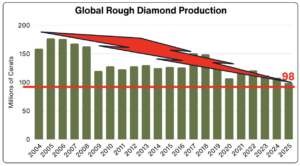
La chiusura arriva in un mercato molto diverso da quello degli anni d’oro: domanda poco dinamica, focus sulla qualità più che sui volumi, e un’offerta che si sta ridimensionando. In questo contesto, i 4 milioni di carati annui di Diavik non peseranno sul riequilibrio del settore.
Leggi l’articolo completo di “The Diamond Press”:
In some sense, it was a historic week for the diamond industry, as Rio Tinto announced the closure of the Diavik mine in Canada.
The significance of the announcement is threefold.First, it marks the end of a consistent source of supply. The mine was launched in 2003 and yielded around 153.8 million carats over its life, an average of about 6.8 million carats a year, though that settled closer to 4 million in recent years.
Second, it effectively completes Rio Tinto’s exit from diamond mining, following the closure of the Argyle mine in 2020. The company still has an early-stage exploration project in Angola, Chiri, but Diavik’s closure marks the first time Rio Tinto won’t be mining diamonds since it began operations at Argyle in 1985.
Barring De Beers, Rio Tinto has arguably been the most influential company in the industry over that 40-year period. Its impact extended beyond the sheer volume from Argyle and Diavik, as it helped create new categories of demand through marketing, most notably repositioning brown diamonds as desirable champagne and chocolate toned pieces.
Rio will continue to operate as it sells down inventory, and will keep marketing Diavik production through 2026.
Finally, the closure of Diavik signals the twilight of Canada’s diamond era. It leaves Ekati and Gahcho Kué as the only operating mines in the country. While Burgundy Diamond Mining plans to extend Ekati’s life to around 2040, Gahcho Kué, a joint venture between De Beers and Mountain Province Diamonds, is slated to wind down around 2031. Expansion projects at Gahcho Kué have been put on hold, and while greenfield exploration programs continue, they have lost much of their economic promise as market conditions have deteriorated.
That leaves Canada as a fringe operator in the diamond market, a sharp shift from being the most exciting new source of production through the 1990s and early 2000s. The focus for new supply is now turning to Angola, where the likes of Rio Tinto and De Beers are investing in kimberlite exploration.
But Canada enters its twilight years with the diamond industry in a very different state to the one it found. As demand has stagnated, the mining segment now operates on a different economic model, one in which the quality and value of production are the most important metrics, rather than high-volume, broad-based demand.
The timing of Canada’s diamond rush was most fortunate, as Diavik, Ekati and, to a lesser extent, Gahcho Kué were discovered in the middle of a volume-driven era of diamond demand.
Today’s reality is different. In that sense, the diamond industry might welcome the closure of Diavik. The mine should be recognized for all it contributed, but its roughly 4 million carats of annual production will not be missed as the market realigns supply with the prevailing lower levels of demand.